
How Much Electricity Do Permanent Christmas Lights Use?
In this article
- What Are Permanent Christmas Lights?
- How Much Electricity Do 300 LED Pixels Use?
- What Would That Cost on a Nanaimo Electricity Bill?
- What Else Changes the Electricity Cost?
- Do Permanent Lights Save Electricity Compared With Seasonal Lights?
- So, How Much Electricity Do Permanent Christmas Lights Use?
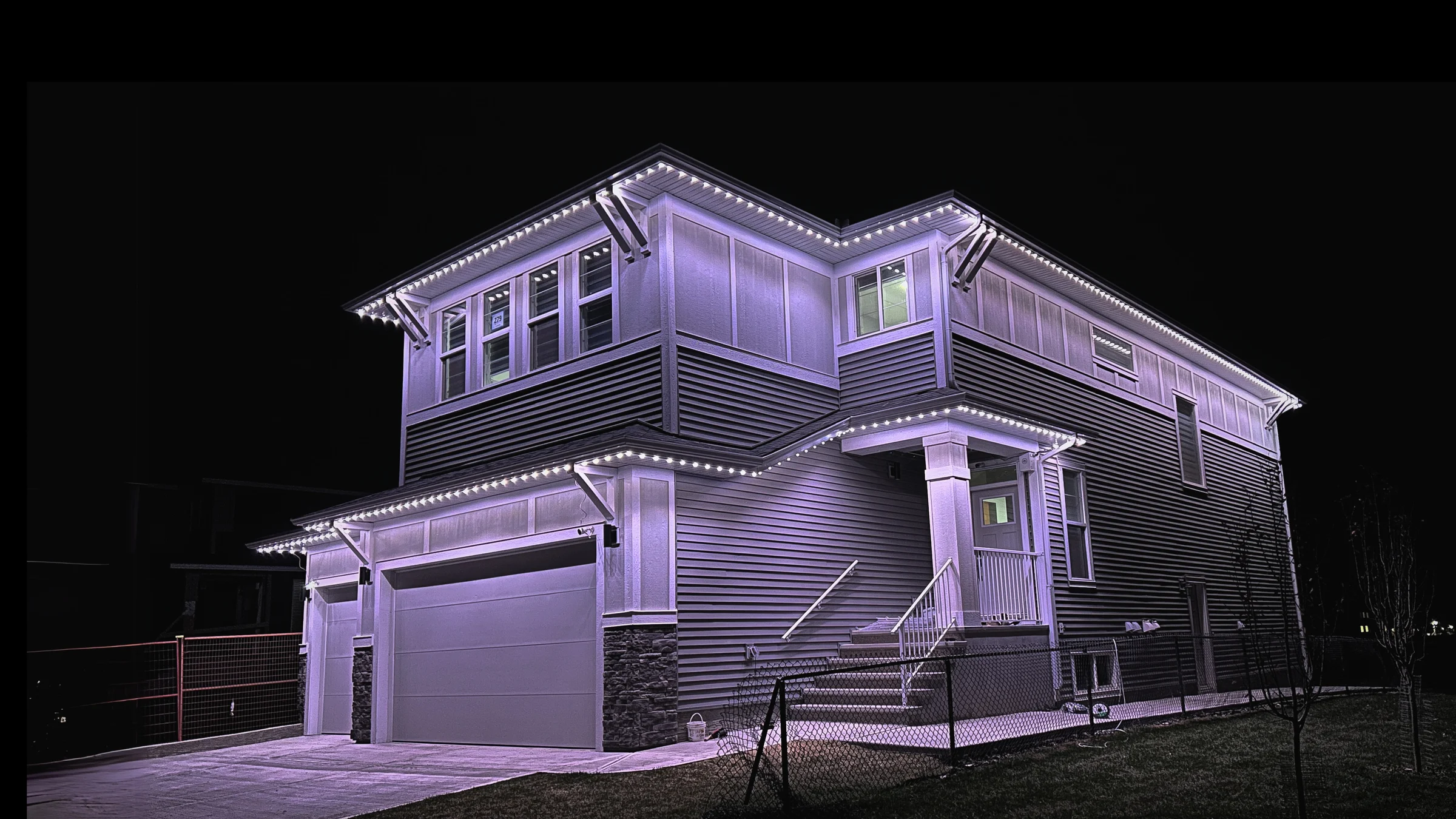
October is almost here in Nanaimo. Soon Halloween decorations will go up, followed by Christmas lights. You may have noticed more permanent lights on homes across Vancouver Island, too. One night they’re warm white. The next, they’re orange for Halloween or red and green for Christmas. Nobody has to climb a ladder to change them.
That convenience sounds great, but what does it do to your electricity bill?
Short answer: The LEDs in a 300-light home would cost less than $15 per month to run for 10 hours every night at their maximum rated power, using BC Hydro’s September 2026 Tier 1 rate. The calculation is about $13.46 including GST for the LEDs. A lower brightness setting or shorter schedule could bring the total down.
This guide explains what permanent Christmas lights are, how much electricity each bulb uses, and how to calculate the monthly cost for a home in Nanaimo.
What Are Permanent Christmas Lights?
Permanent Christmas lights are small LEDs installed in a track along your roofline or soffits. They stay in place year-round and blend into the home during the day. An app lets you choose warm white lighting for an ordinary evening or colours and patterns for holidays and events.
Clear Choice Lighting installs Prairie Lighting’s 30 mm Pro pixels. According to Prairie Lighting’s product specifications, each pixel is rated at a maximum of 1.2 watts. The system runs at 24 volts, but voltage does not tell you how much electricity it uses. For that, you need the wattage, number of lights and hours of use.
How Much Electricity Do 300 LED Pixels Use?
Start With the Power Draw
If all 300 pixels operate at their published maximum, the calculation is:
300 lights × 1.2 watts = 360 watts, or 0.36 kilowatts.
Add the Hours You Run Them
A 10-Hour Nightly Schedule
0.36 kilowatts × 10 hours × 30 nights = 108 kilowatt-hours (kWh) per month.
This is a calculation for the LEDs, not a measurement at the home’s electrical outlet. The controller and power supply add some use, while dimming or patterns that leave some pixels off can reduce the LEDs’ use. A 10-hour, maximum-power display is a useful example, but it won’t describe every evening.
What Would That Cost on a Nanaimo Electricity Bill?
As of September 2026, BC Hydro’s Tier 1 residential energy rate is 11.87 cents per kWh. BC Hydro also applies 5% GST to residential electricity.
For our example, 108 kWh × $0.1187 = $12.82, or about $13.46 including GST for the LEDs. That is where the less than $15 per month figure comes from. It does not include electricity used by the controller or power supply. BC Hydro’s basic account charge is also excluded because you pay it whether you install lights or not.
What If I Run the Lights for Fewer Hours?
These examples use the same 300 lights at their rated maximum. They assume all added LED use is charged at the Tier 1 rate and include GST:
| Hours per night | LED use in 30 days | Estimated LED electricity cost |
|---|---|---|
| 4 hours | 43.2 kWh | $5.38 |
| 6 hours | 64.8 kWh | $8.08 |
| 8 hours | 86.4 kWh | $10.77 |
| 10 hours | 108 kWh | $13.46 |
You can choose a shorter schedule without giving up the evenings when the lights look their best.
Is Tier 1 BC Hydro’s Overnight Rate?
No. Tier 1 is the price for electricity used below a household’s billing-period threshold. It applies regardless of the time of day.
The 11 p.m. to 7 a.m. overnight discount belongs to BC Hydro’s optional time-of-day pricing. If you have selected that option, electricity used during those hours gets a 5-cent-per-kWh discount. Electricity used from 4 to 9 p.m. gets a 5-cent surcharge, while the other hours have no adjustment. Check your bill or BC Hydro account before assuming your lights receive an overnight discount.
What Else Changes the Electricity Cost?
Number of Lights
A larger roofline usually needs more pixels. At the same brightness and schedule, 500 lights use more electricity than 300. The number on your quote is more useful than an estimate based on someone else’s house.
Brightness and Effects
A soft everyday setting may use less power than a bright display. Animated effects can also leave some pixels off part of the time. Colour alone doesn’t determine the cost; the number of lit pixels and their brightness matter.
Your Schedule
Set the lights to turn off when you no longer need them. At the same settings, five hours uses roughly half as much LED electricity as ten hours.
Do Permanent Lights Save Electricity Compared With Seasonal Lights?
They can use much less power than old incandescent Christmas lights. Modern seasonal LED strings are efficient too, so switching from one LED system to another does not guarantee a lower bill. The bigger difference is that permanent lights stay in place and can serve as everyday lighting as well as Christmas lights.
If you’re weighing the total investment, read our Nanaimo permanent lighting pricing guide. Want to picture them on your home? Browse the Clear Choice gallery, then request an estimate for your roofline.
So, How Much Electricity Do Permanent Christmas Lights Use?
For our 300-light Nanaimo example, running the LEDs at their rated maximum for 10 hours a night uses 108 kWh in a 30-day month, or $13.46 including GST at BC Hydro’s Tier 1 rate. Eight hours a night brings the LED calculation down to 86.4 kWh and $10.77. You can use even less by dimming the lights, turning off zones you don’t need, and setting an automatic shutoff.
That’s roughly the cost of one takeout lunch each month. In return, you get one system with 16 million colours for everyday architectural lighting, subtle accent lighting, Christmas and special events. The pixels are rated for up to 100,000 hours, which can mean about 25 years of regular nighttime use.
Want to see what that looks like on local homes? View our gallery, or get an estimate for your own roofline.
Keep exploring
Return to the blog